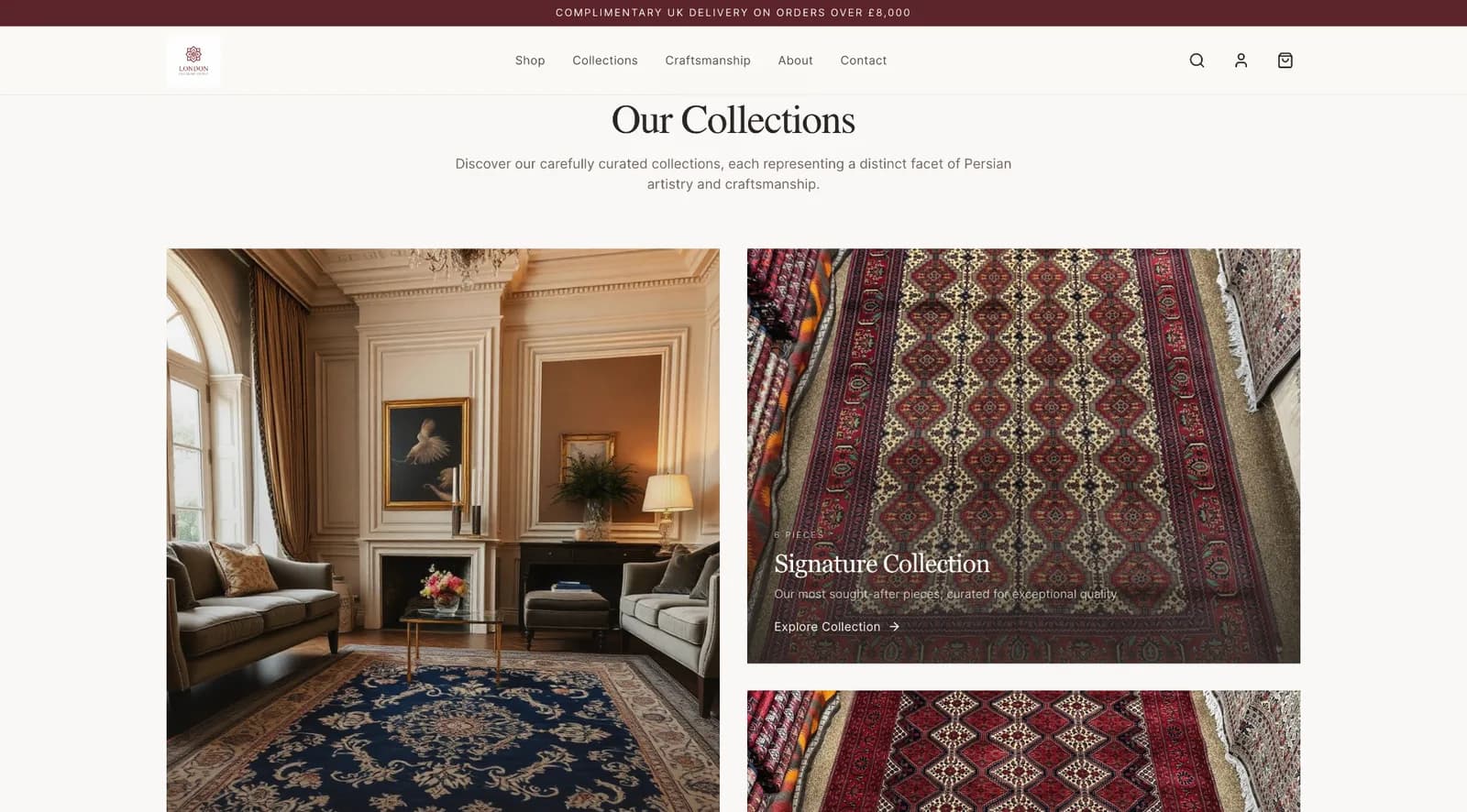
Flooring and rugs, London
London Flooring Group londonflooringgroup.com
A luxury showcase for a London flooring and rug house trading since 1985: Persian and Turkish rugs, engineered wood and bespoke fitting.
TitanStudio, a London web design studio working UK-wide, builds websites for builders. You get a gallery of finished jobs, a quote form that tells you what the work involves, and local pages for the areas you cover. The site is live in 21 days from the day we have your content.
Book a call
Pick a time that suits you. We will confirm by text or email.
Next working days, UK time
30 minute slots
Prefer to talk now? +44 7337 522762

They land on a page of vague promises, no finished kitchen, no rear extension, no full refurbishment. They want to see a job like theirs. With none in sight, they ring the builder whose photos they have seen.
You have finished some lovely jobs, but the photos are in a camera roll and a few Facebook posts. A homeowner comparing three builders will not dig for them. Work they cannot see does not count.
A one-line message saying 'need a quote' costs you a phone call, a site visit and half a day to find out it was a small repair. Without a form that asks the right questions, you chase every lead blind.
You build well in a handful of boroughs or towns, but your site never says so. A homeowner searching for a builder near them finds the firm that names their area and shows work nearby.
A kitchen extension buyer wants kitchen extensions. A refurbishment buyer wants whole-house work. Group your gallery by job type so each visitor finds their own project in seconds.
Homeowners worry about strangers in their house. Say whether you use your own team or trusted subcontractors, and show real faces. A named person feels safer than a logo.
They look for proof you are insured and whether you belong to a trade scheme. State only what is true and current, and tell visitors to check registration for themselves.
Will you visit first? Is the quote written and itemised? Does it say what is excluded? Explaining your process up front removes the fear of surprise costs later.
A builder who may not travel to them is a wasted call. Name the boroughs, towns or counties you work in, so the right people ring and the wrong ones do not.
Genuine words from named customers, with the job they had done, carry more weight than any slogan. If you have none yet, leave the section out rather than invent any.
Kitchen extensions, renovations, new builds and repairs each get their own filter. Every project has a short note on what was done, so a homeowner sees work close to theirs.
The form asks for the type of work, the postcode, a rough timescale and photos. You get an enquiry you can price or politely decline, not a mystery message.
Most builders are on a ladder or in a van, and customers browse on their phones. A tap-to-call button stays within reach, so the call comes in while interest is high.
One page per area you cover, each with local jobs and a plain description of your work there. This is how homeowners nearby find you, and how search engines understand where you work.
Survey, written quote, start date, daily progress, snagging. Setting out the steps calms the nerves of a first-time renovator and filters out people who are not ready.
We set up instant alerts to your phone and email, plus tracking, so you can see which pages bring the calls. The domain and set-up are handled by us and the site is yours.
A website for a builder is scoped to the firm, so there is no single price. Every project is quoted individually, and you get a fixed written quote within 24 hours of your enquiry. There are no fixed packages and no surprises later.
What drives the scope for a building firm is straightforward. The number of job types you want shown, the volume of finished projects in the gallery, how many areas you want pages for, and whether you need extras such as a longer process section or a reviews feed.
A one-man builder in two boroughs needs less than a firm with five teams across the south-east. Either way, we write the copy, build the site, set up your enquiry alerts and domain, and you own the site and every asset. Ask for the quote and compare it with what you get.
A builder's gallery should be sorted by the kind of job, not the date it was finished. Homeowners are looking for work like their own, so filters for extensions, kitchens, renovations and repairs matter more than a timeline.
Each project needs a few lines: the type of property, what you did, and roughly how long it ran. Show the start as well as the finish. A bare room tells a homeowner that you can handle a mess and bring order.
Take photos in daylight, avoid tight crops and use the same angle before and after where you can. If you have too few good photos, we can talk through what to shoot on your next job. This is the part of web design for builders that does most of the selling, so it is worth doing properly.
Local pages tell homeowners and search engines where you build. A builders web designer who sets these up properly gives each area its own page, with real jobs and a plain account of the work you do there.
Homeowners often search for a builder alongside the name of their town or borough. A single page listing twenty places is thin. A page for each main area, with a local project and the streets or districts you know, is far more useful to the reader.
We structure the site properly for search, but nobody can promise a ranking. What we can promise is a site that is clear about what you do and where, which is what both homeowners and search engines look for.
Sites we have built for UK firms that sell on trust, craft and detail.
Flooring and rugs, London
A luxury showcase for a London flooring and rug house trading since 1985: Persian and Turkish rugs, engineered wood and bespoke fitting.
Property services
A four-pillar institutional site for a property services group, built to be fast, to build trust and to turn enquiries into contracts.
A quick call about your firm, the work you want more of and the areas you cover.
You send photos, reviews and accreditations. We write the copy and shape it around your trade.
We design and build the site, you review it, and we refine it with you.
Domain, tracking and enquiry alerts are set up, then your site goes live.
Live in 21 days from the day we have your content.
See all of our construction and trades website design.
Finished jobs sorted by type, who you are, the areas you cover, your insurance, how a quote works and an easy way to ask for one. Real photos beat any slogan. Leave out anything you cannot prove.
Often yes. Referred customers still look you up before they ring. If they find nothing, or something dated, some will ring another builder. A good site backs up the recommendation you already earned.
Yes. We can build around what you have and advise what to shoot on your next jobs. We do not use stock photos of other people's work. A smaller, honest gallery is better than a padded one.
It is live in 21 days from the day we have your content, meaning your photos, details and any reviews. We write the copy and build the site, so you do not need to supply a finished draft.
Yes. You own the site and all its assets, including the photos, copy and design files we produce. We set up your domain, enquiry alerts and tracking, and you are not tied to us to keep the site running.
Yes. We are based in London and work UK-wide. Your site can name as many areas as you cover, with a page for each main one, whether you work in one borough or several counties.
Tell us about your firm and the jobs you want more of, and we will send a fixed written quote within 24 hours.
Live in 21 days from the day we have your content.
Book a call
Pick a time that suits you. We will confirm by text or email.
Next working days, UK time
30 minute slots
Prefer to talk now? +44 7337 522762
Last updated 28 October 2026