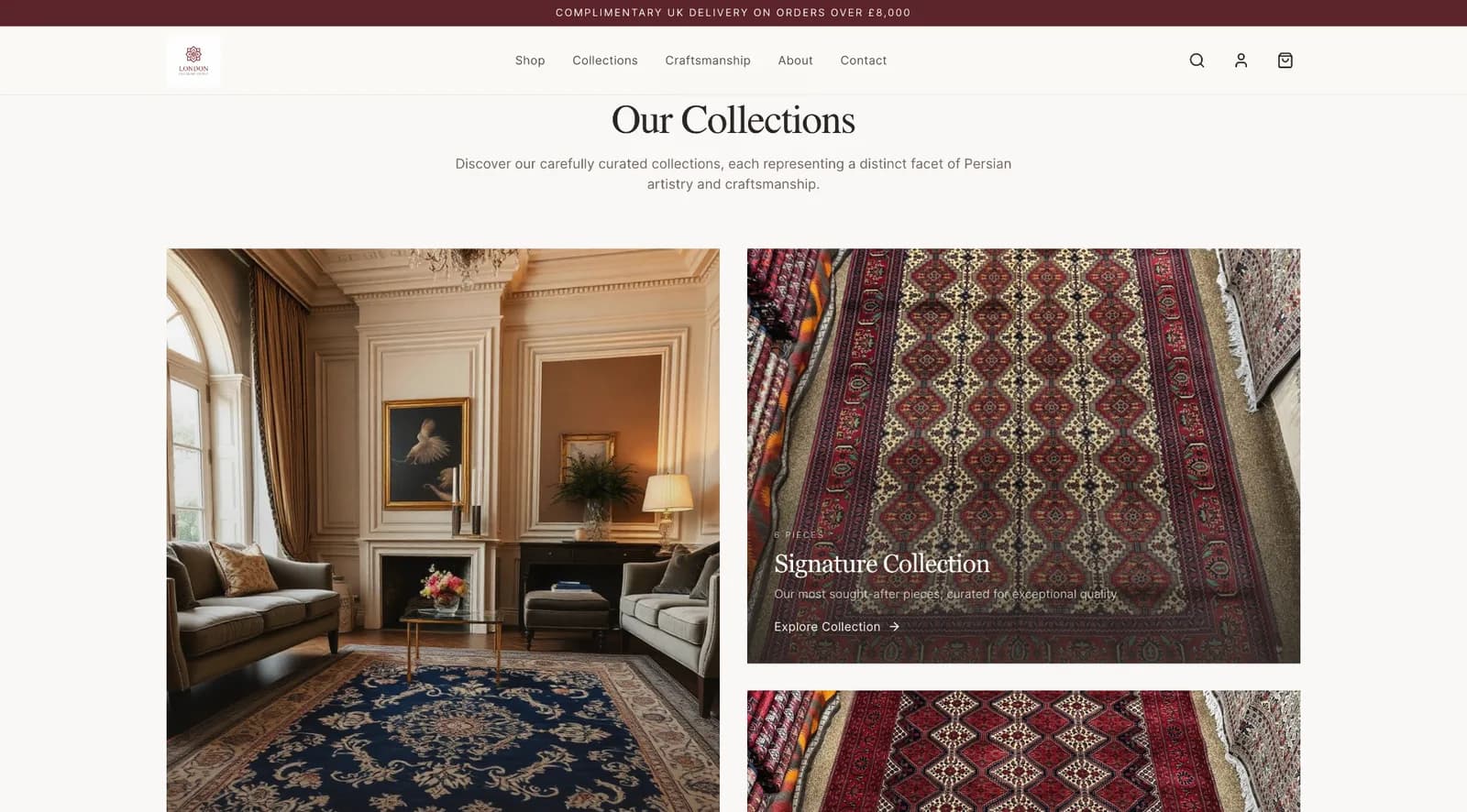
Flooring and rugs, London
London Flooring Group londonflooringgroup.com
A luxury showcase for a London flooring and rug house trading since 1985: Persian and Turkish rugs, engineered wood and bespoke fitting.
TitanStudio, a London web design studio working UK-wide, builds websites for window and door companies: product galleries by style and frame, your certification and guarantee explained clearly, and a quote form that captures how many windows and what type. Your site is live in 21 days from the day we have your content.
Book a call
Pick a time that suits you. We will confirm by text or email.
Next working days, UK time
30 minute slots
Prefer to talk now? +44 7337 522762

A sash, a casement and a bifold shown in one cramped gallery look identical. Buyers cannot see the sightlines, the finish or the fit.
Customers hear about certificates and guarantees but a site that never explains them leaves the question open. They pick the firm that does.
uPVC, aluminium and timber are different buys. If your site does not explain the difference, people call three firms to ask and may stay with whichever answered best.
"Need new windows" could be one bedroom or a whole house. Without counts, types and a postcode, every enquiry needs a call just to start.
A buyer wanting timber sashes in a conservation area and one wanting uPVC casements look for different things. Pages per product and frame let each find a clear answer.
Buyers look for whether the company belongs to an installer scheme such as FENSA or Certass, and what certificate they receive. Name the scheme you hold and how to check it.
They want the guarantee in plain words: how long, what is covered, who stands behind it. Keep it to what you actually give and avoid vague promises.
Finished houses with your frames in them, not catalogue shots. Buyers look for properties like theirs: terrace, semi, flat, period home, so label each install by property type.
Survey, quote, measure, manufacture, fit. People want to know how many visits, what disruption to expect and what happens with the old frames. Set it out step by step.
Fitters cover set areas, and customers check yours before they ask. List the towns and boroughs, and show completed jobs from them, so local buyers can see your frames nearby.
Sash, casement, tilt and turn, composite doors, bifolds, patio doors, each with finished installs. Visitors browse by what they want and see it on real homes.
How many windows or doors, the style, the property type and the postcode, with room for a photo. You can give a sensible first answer without a wasted call.
The installer scheme you belong to, the certificate a customer receives and how to check you, in plain words. We never imply endorsement by a scheme and use no logo without permission.
Length, what is included and what the customer does if something goes wrong. Written to match what you really offer, so the page never promises more than your paperwork does.
uPVC, aluminium and timber compared fairly, with who each suits. Buyers get the answer from you instead of from the next firm on the list.
A page per town or borough, with installs done there. Local customers see your frames on their roads, and local search has real content to read, written for that area.
A window and door company should explain certification as three plain facts: which scheme you belong to, what certificate the customer gets, and how they can check you. Anything beyond that invites errors.
Replacing windows and doors in a home generally has to meet the Building Regulations. FENSA describes itself as a government-authorised scheme that monitors compliance for replacement windows and doors, and says a certificate can only be obtained through an approved installer, who also handles the council registration. Certass, a UKAS-accredited certification body, says its approved members can certify their installations to current Building Regulations. Check the current rules and your own scheme's terms before stating any of this as your own.
We never imply that a scheme endorses your website, and we do not use scheme logos without permission. A short, accurate section beats a row of badges.
A window company should organise products by what the buyer is trying to do, not by how the factory lists them. People arrive wanting new sashes, a front door or bifolds to the garden, so give each its own page.
Each page should show finished installs on real homes, name the frame materials and finishes you offer and say who each suits. A buyer in a period house wants to know about proportions and sightlines. A buyer in a new-build semi wants to know about security and upkeep. One page cannot serve both.
Add a short comparison of uPVC, aluminium and timber, so the choice is explained by you, not by whoever the buyer rings next. If you have a showroom, give the address and opening times, and make it clear whether visits are by appointment.
A website for a window and door company is scoped per project, so there is no fixed package and no number on this page. You get a fixed written quote within 24 hours of your enquiry.
What drives the scope: how many products and materials need their own pages, how much install photography there is to organise, whether you have a showroom to feature and how many areas you want pages for. A firm with two or three products in one area is a smaller job than a manufacturer-installer with a full range.
Whatever the scope, you own the site and everything on it, we write the copy and build it, and it goes live in 21 days from the day we have your content. Web design for window and door companies should be quoted in writing, before the work starts.
Sites we have built for UK firms that sell on trust, craft and detail.
Flooring and rugs, London
A luxury showcase for a London flooring and rug house trading since 1985: Persian and Turkish rugs, engineered wood and bespoke fitting.
Property services
A four-pillar institutional site for a property services group, built to be fast, to build trust and to turn enquiries into contracts.
A quick call about your firm, the work you want more of and the areas you cover.
You send photos, reviews and accreditations. We write the copy and shape it around your trade.
We design and build the site, you review it, and we refine it with you.
Domain, tracking and enquiry alerts are set up, then your site goes live.
Live in 21 days from the day we have your content.
See all of our construction and trades website design.
If you hold one, yes. Name the scheme, say what certificate the customer gets and link to the scheme's own checker. We use no scheme logos without permission and never suggest endorsement.
Yes. We write it to match your paperwork: how long, what is covered and what to do if something goes wrong. If you are unsure of the wording, check it with whoever backs the guarantee.
We build a page per product and material, with finished installs on real homes and a short note on who each suits. Buyers find their own case fast, and each page can be found on its own in search.
You can mention them if you work in them. Rules there are set locally and change, so we word it as a prompt to check with the council, not as advice.
It will if it asks the right things. We build it around number of openings, style, material, property type and postcode, with room for photos, so you can answer with a sensible first view.
We write the copy and build the site. You own the site and every asset on it. A London window company and one elsewhere in the UK get the same service.
Tell us your products, your scheme and where you fit. You get a fixed written quote within 24 hours.
Live in 21 days from the day we have your content.
Book a call
Pick a time that suits you. We will confirm by text or email.
Next working days, UK time
30 minute slots
Prefer to talk now? +44 7337 522762
Last updated 28 October 2026